Two claims, two contracts
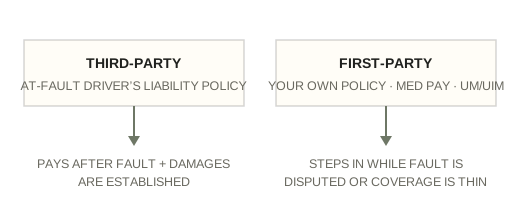
After a collision there are two insurance relationships, and they work differently:
- Third-party claim — against the at-fault driver's liability policy. It pays only after fault and damages are established, and it pays what is owed, up to the policy limits.
- First-party claim — against your own policy: collision coverage for your car, medical payments coverage where carried, and uninsured/underinsured motorist (UM/UIM) coverage, which steps in when the at-fault driver has no or insufficient coverage.
UM coverage is required on California policies unless waived in writing (Insurance Code §11580.2). What the minimum limits are, and what they do not cover, decides how far any claim can go.
The structure of a third-party claim
| Stage | What happens | What it produces |
|---|---|---|
| Fault | Which driver was negligent, and by what percentage. California applies pure comparative negligence — recovery is reduced by your own share of fault, not eliminated by it. | The liability decision |
| Damages | Economic losses (bills, wages) and non-economic harm (pain and suffering), each documented from the record. | The demand |
| Negotiation | Exchange between the claim and the adjuster, bounded at the top by policy limits. | Settlement or suit |
What the policy limits mean in practice
The at-fault driver's bodily-injury limit is a ceiling on the third-party claim, not a target. A $30,000 policy (the post-SB 1107 minimum) caps what that policy pays for one person's injuries — and that is where UM/UIM coverage on your own policy becomes the second line of the structure.
The statutory frame
- Coverage minimums — Insurance Code §11580.1b requires every policy to provide minimum liability coverage; Vehicle Code §16056, as amended by SB 1107, raised those minimums to $30,000 bodily injury per person, $60,000 per accident, and $15,000 property damage for policies issued or renewed on or after January 1, 2025.
- Reporting — Vehicle Code §20008 requires the SR-1 report to the DMV within 10 days for qualifying collisions. See the reporting file.
- Filing deadline — Code of Civil Procedure §335.1 gives two years from the date of injury to file a personal-injury lawsuit. Exceptions exist; applying them to a specific case is a lawyer's job.
What this desk does not do
No settlement figures, no valuation calculators, no averages. The value of any claim is established the slow way — liability, documented damages, negotiation — and any number quoted without that record is a guess wearing a decimal point. What the record does, this desk explains; what the claim is worth, it does not.
An offer made before the full course of the injury is documented prices an incomplete record. Whether to accept any offer is legal advice — this desk gives none.